Addressing Bifurcation in Evolutionary Dynamics Through Singular Learning Theory
This blog explores the idea of Singular Learning Theory being applied to challenges in evolutionary dynamics modeling.

Introduction
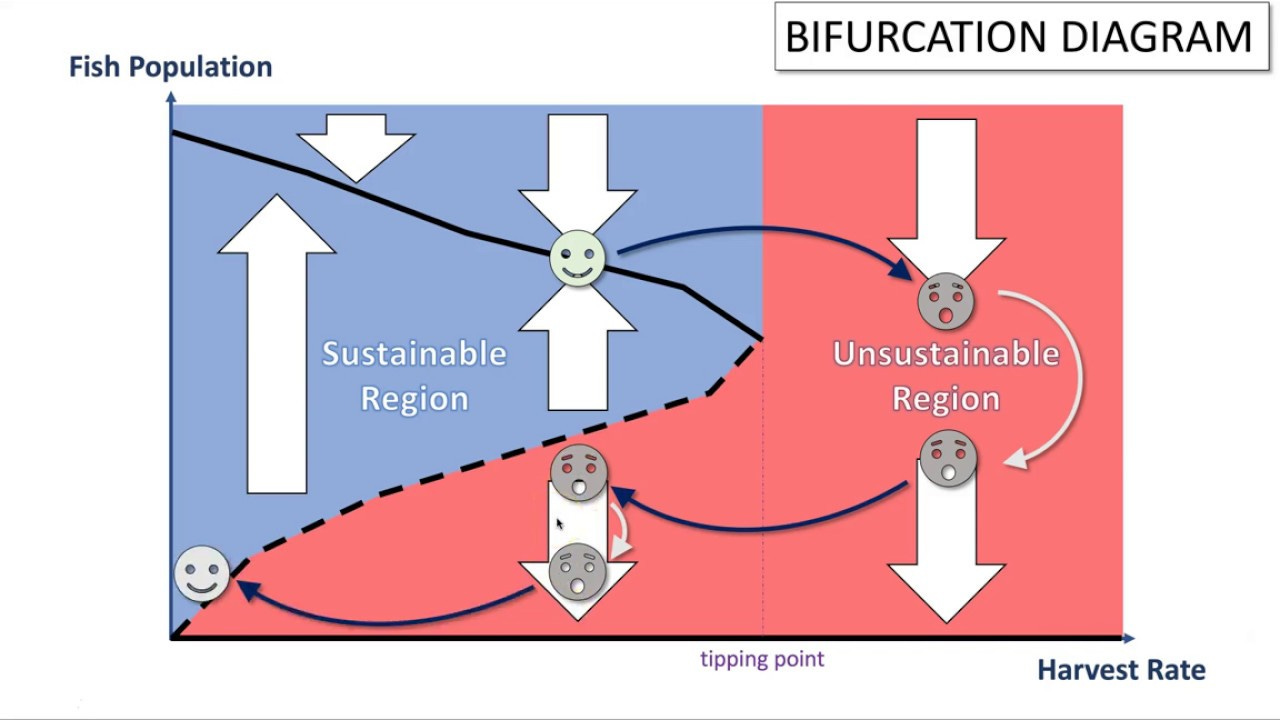
In the complex world of evolutionary dynamics, systems often undergo abrupt changes that defy standard linear predictions. These sudden shifts, known as bifurcations (source), mark critical transitions where a small change in parameters leads to a qualitative change in system behavior. Singular Learning Theory (SLT), a mathematical framework traditionally used in statistical learning, offers fresh insights into these phenomena. This blog explores how SLT can illuminate our understanding of bifurcation points in evolutionary dynamics modeling.
Singularities in Nature
Singular Learning Theory extends conventional learning theories to models with singularities—points where standard statistical methods fail due to non-identifiability or degeneracy. In evolutionary dynamics, bifurcation points are analogous to these singularities. At these critical junctures, small perturbations can lead to new equilibrium states or entirely different evolutionary pathways.
Case Study: Crop Adaptation Under Climate Change
Climate change is introducing extreme environmental stresses, such as increased temperatures, droughts, and heatwaves, which pose significant threats to crop species essential for human agriculture and the global economy. Staple crops like wheat, maize, and rice are particularly vulnerable. These climatic stresses negatively impact plant physiology, leading to reduced growth, development, and yield. For instance, heat stress can diminish grain production, cold stress can cause sterility, and drought stress adversely affects the morphological and physiological aspects of plants (source).
Understanding how crops adapt to these stresses is a complex challenge due to the intricate interplay of genetic, environmental, and physiological factors. Traditional models often struggle near bifurcation points—critical thresholds where minor environmental changes cause significant shifts in crop behavior or population dynamics. This is where SLT may be a useful tool.
SLT handles models with non-identifiable parameters, a common issue near bifurcation points caused by the complex nature of crop responses to climate stressors. By analyzing the geometry of these singular parameter spaces, SLT can predict how crop systems might behave near critical transitions induced by climate change. This approach allows researchers to model potential evolutionary leaps or sudden shifts in crop performance as transitions through singularities in the fitness landscape.
For example, wheat, a leading staple crop cultivated on a large scale globally, provides a significant portion of dietary protein. However, it's projected that even a 2 °C increase in global temperatures could lead to a substantial reduction in wheat yields (source). This reduction is primarily due to shortened grain-filling periods and other physiological stresses caused by elevated temperatures. By applying SLT to models of wheat growth under varying climatic conditions, researchers can identify potential bifurcation points where abrupt declines in yield might occur.
Using SLT, agricultural scientists can:
Analyze the Impact of Temperature Fluctuations: By understanding how environmental changes affect the non-identifiable parameters in crop models, SLT can help predict critical points where crops might fail to thrive.
Develop Stress-Resistant Varieties: SLT could aid in identifying genetic traits that contribute to stress resistance, guiding breeding programs for more resilient crop varieties.
Forecast and Mitigate Risks: Anticipating critical transitions allows for proactive measures, such as adjusting planting schedules or implementing irrigation strategies to counteract drought stress.
By incorporating SLT into the study of crop adaptation, we gain a powerful tool to model and predict the effects of global warming on essential agricultural species. This approach not only advances our theoretical understanding but also has practical implications for ensuring food security and economic stability in the face of climate change.
Conclusion
Understanding bifurcations through SLT has significant practical benefits:
Enhanced Food Security: Predicting critical transitions in crop performance allows for timely interventions to prevent food shortages.
Economic Stability: Protecting staple crops from the adverse effects of climate change supports the agricultural economy and global markets.
Sustainable Agriculture: SLT-guided strategies contribute to developing sustainable practices that can withstand environmental stresses.
By leveraging Singular Learning Theory, we can better navigate the challenges posed by climate change, ensuring that key agricultural species continue to thrive and support human societies worldwide.